
Tenebris Somnia
I first watched ManlyBadassHero play the demo for *Tenebris Somnia* several years ago and was immediately excited for the full release. The mix of pixel art and gorgeous full-motion video (FMV) hooked me.
Years passed and I became skeptical that the game would ever release. When it finally came out, I was beyond delighted. Don't get me wrong -- I think indie studios should take as long as they need to in order develop their games. I've just seen so many games get stuck in development for a decade or more. Or never come out. So I'm patient, but I don't tend to invest a lot emotionally in some indie games that display a lot of ambition in their scope.
But the recent rise of FMV game rediscovery got me more interested than I might normally be. Moreover, this is an FMV game that doesn't feel the need to remain devoted to the aesthetic of 90s games. It's a fresh take on the genre and I appreciate that. Retro-style horror indie games are my usual beat, but I often get the impression that developers try too hard to adhere to that "retro" aesthetic without bringing anything new to the table.
I'm happy to say that wasn't my experience with Tenebris Somnia.
However, I am frustrated with some of the YouTubers who have covered this game. We'll get there.
This will be a long, rambly one and probably a little incoherent. Definitely full of spoilers. So be forewarned.
Tenebris Somnia follows Julia, a woman who checks in with her ex-boyfriend, Iván, after having dreams about him being ripped apart by demons. They'd previously lived together and she still has the key to their old apartment. As you might imagine, things go sideways almost immediately. The demons are real and they're actively fighting against Julia in her quest to find her ex.
Right off the bat, alarm bells started ringing. Why does Julia care so much about rescuing her ex? She's the one who left him, so this doesn't seem like something logical to do. She also remembers him in a very positive light: he's an auteur filmmaker, he took her to fancy dinners, he only wanted the best for their future.
So why, then, did she leave him?
We find out that she ran off in the middle of a movie release at their favorite theater. In the rain. She grabbed the essentials from their shared apartment and disappeared, quite literally, into the night.
This is where I break from the way some content creators have covered this. I've seen many say "wow, she could've handled that better" or "she's so bad at communication". Not a deal breaker -- I'll continue to watch them -- but a bummer. There are so many little breadcrumbs along the way that lead us towards something more sinister at hand and Julia is, in fairness, an unreliable narrator. But not for the reasons you'd expect.
Still, a woman in a healthy, happy relationship doesn't simply abandon that relationship without a word. There's a reason, even if it's just a gut instinct.
Early in the game we find an item that provides the most damning proof that Iván isn't the amazing partner Julia thinks he was. An x-ray print. An x-ray print of her shoulder. An x-ray print of her shoulder that was injured when they were on vacation.
The alarm bells have broken from ringing so hard. This guy's bad news. But Julia doesn't elaborate on the incident. In fact, she doesn't completely remember what happened or how or why Iván injured her. But my stomach had fully dropped. I think any person who has been in a situation where domestic violence is involved knew where this was going.
This vacation becomes linked, within the visual language of the game, with the moon. Julia took a photo of the moon from their hotel suite in Mendoza. We see this photo and the Mendoza scene at a couple different points in the narrative.
The first time, we get an outsider perspective. We're in the game, in the pixel art, almost as removed from the scene as Julia is from her memory of the scene.
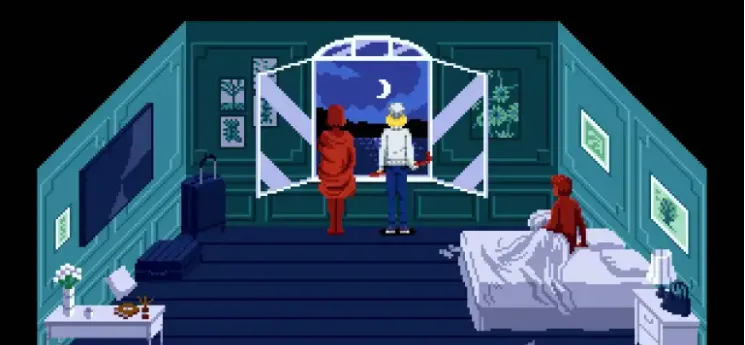
She's staring at the moon.
Put a pin in that.
To the surprise of all the streamers I've seen, but no surprise to me, Iván betrays Julia. His plan was to wipe all but the barest traces the memories she has of their time together and lure her into this other realm so he can steal the corrupted part of her soul that still loves him. He wants to make sure she never abandons him again. Because NO ONE abandons him.
After this betrayal, Julia barely escapes with her life. She's able to regain her memories and see Iván for what he was: a liar, a self-important asshole, and an abuser.
He stole all credit for Devora and broke ties with his Devora co-writer. Stole Julia's ideas and self-confidence. Made her responsible for the entirety of his well being after the mental break he had when his short film wasn't picked up for a full-length adaptation. How she wanted out. How he threatened to hurt himself when she told him she'd leave.
And what happened at that hotel room in Mendoza.
We get an FMV cutscene. Julia's in the hotel room, back pressed to the door. The camera holds on her face then barely pans out to give us the barest glimpse of the scene, while the focus remains on Julia. Iván is in the middle of forcing her down onto the bed. Cut to a full-screen shot of the moon over the lake -- the same framing from Julia's photo. The grief on Julia's face as full realization washes over her had me in tears as well. But we both steel our resolve and move into the endgame.
I've seen people hedge on what this scene could mean. What did Iván actually do to her? To be honest, I'm baffled as to why this is even a question. It wasn't simple assault or an accident. Iván violently raped Julia.
To read it as anything else belies a discomfort with the subject matter that obfuscates someone's ability to understand the full implication of what we're shown. I don't blame someone for that, but I do invite anyone who did to question why you'd hesitate when the narrative is so explicit.
The developers handled this revelation with a deft, but sure hand. It's presented in a way that's gut-wrenching without feeling exploitative (as it might and so often does in the hands of a lesser team). As a survivor of domestic violence, I applaud the care that they took. That care moved me as much as the scene itself; albeit in a more positive direction.
There are two main endings and which one you choose determines the final boss you'll face. You either fight Iván or you fight your own Relicta.
Now, personally, I was out for blood. So I killed every Relicta in my path and reveled in their fear. I fought Iván. I got the bad end.
That's when I had my doubts about the game for the first time. Would the message be "forgive your abuser and move on with your life" or "be the bigger person"? I couldn't imagine that, after all I've seen, the developers would choose that path.
So I went for the second ending. I didn't kill any Relicata. I watched them shrink away from my knife and walked by. I fought Lacuna -- Julia's Relicata. And I was surprised. The final message wasn't "forgive your abuser", it was: fuck that guy, honor the parts of yourself that still love him, mourn as you become whole, and reclaim who you are as you heal.
That's true to my experience and I'm sure it resonated with many others.
We end in the best way possible: Julia directs her own short film and debuts it. She's surrounded by her collaborators who are all as excited as she is. We see her struggle with self-doubt and panic during the screening, but she's able to regulate her emotions.
The film's a comedy -- a total break from the overall tone of the game and a subversion of our expectations. It works so beautifully to underscore the game's message. In the final shot, Julia smiles.
It's been roughly two weeks since its release, so I've had a bit of time to let my conclusions marinate. I've given a very rough outline of them here and I still have more to say, but I'll leave you with a glowing recommendation.
Tenebris Somnia isn't a terribly long game. Even with playing through several times, I've logged under 20 hours. My first playthrough took me a little over half of that, since I was so engrossed in the story and explored everything I could. A realistic estimate would be ~6-8 hours to beat.
And definitely go through to find all the Faith: The Unholy Trinity Easter eggs. They're an absolute blast.
We're in an indie horror renaissance now and I feel confident that Tenebris Somnia is and will be regarded as one of the greats in this genre. At the very least, it has become one of my favorite games of all time.